Rabat vs Essaouira: Royal Capital or Windswept Arts Town?
Both face the Atlantic and both are UNESCO-listed, but Rabat is Morocco's monument-rich royal capital, while Essaouira is a small, breezy fishing port turned bohemian arts town. One is about imperial heritage, the other about wind, waves and a laid-back medina.
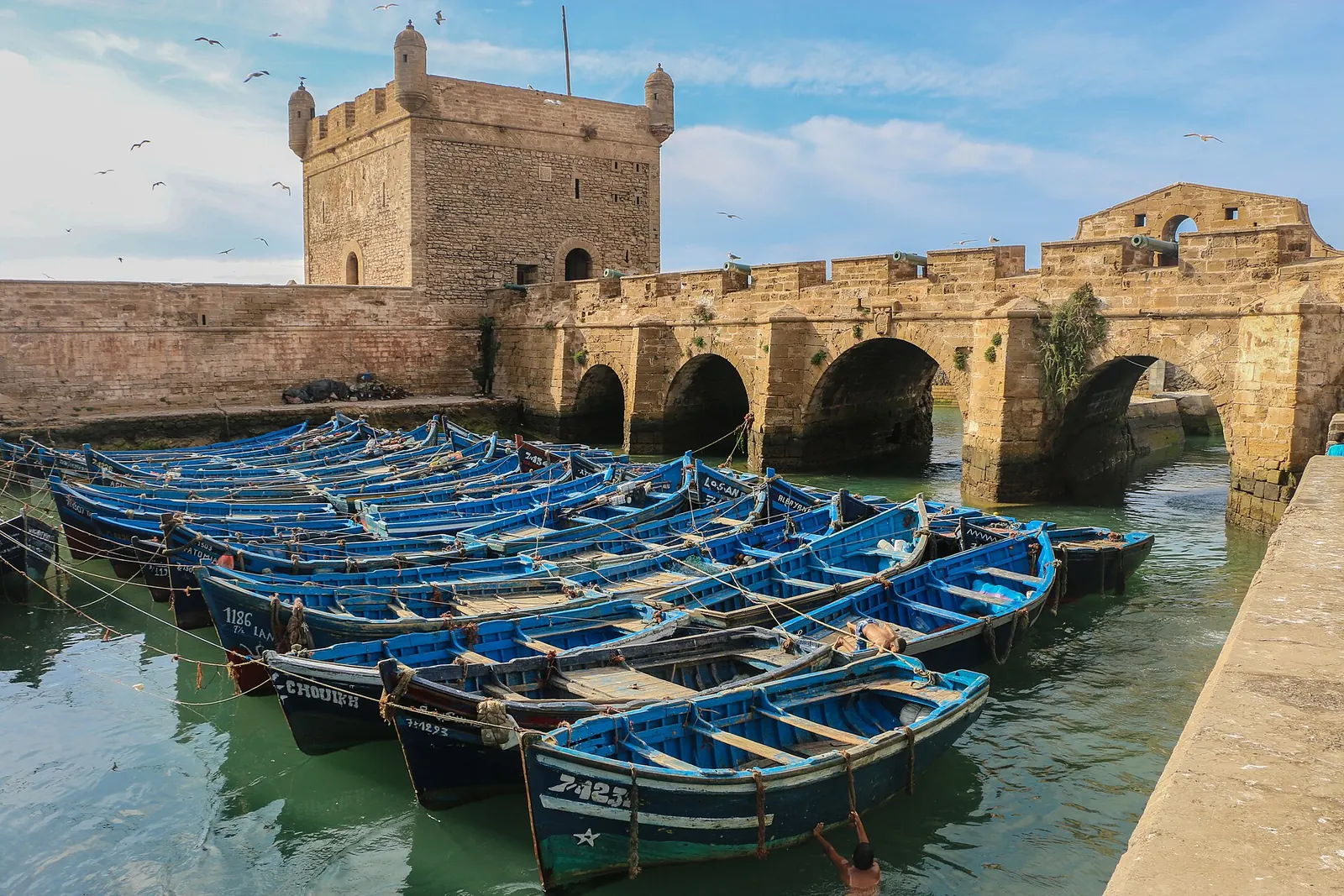
Blue fishing boats moored beneath the Skala fort and stone arches of Essaouira port
Rabat and Essaouira are both Atlantic, both UNESCO-listed and both refreshingly easy by Moroccan standards — yet they suit very different moods. Rabat is the seat of the monarchy: a green, orderly capital where you can walk from the Hassan Tower to the Mausoleum of Mohammed V, taxi up to the blue-and-white Kasbah of the Udayas above the Bouregreg, and end the day among the storks and Roman ruins of Chellah, all with barely a tout in sight. Essaouira, far to the south near Marrakech rather than on Rabat's northern rail corridor, is a small fortified fishing town the locals call the 'Wind City of Africa'. Its 18th-century Skala ramparts, designed in part by a European engineer, look straight out over the breakers; gulls wheel above a working sardine port; and the compact, whitewashed medina is laid out on an unusually walkable grid, full of woodworkers, galleries and gnaoua music. Rabat is imperial grandeur in a calm capital; Essaouira is salt air, art and an unhurried beach town. The two are not really rivals so much as different answers to what you want from the Moroccan Atlantic.
Option A
Rabat
The royal capital — UNESCO medina, four headline monuments and an estuary calm
Best for
Heritage travellers, families, those wanting a well-connected, low-hassle city
How the two stack up across the things that actually shape a trip — read down each column, or across each row.
Category
RabatEssaouira
Rabat compared with Essaouira
Character
RabatCalm royal capital; administrative, green and monument-rich
EssaouiraSmall, breezy arts-and-fishing town; bohemian and laid-back
Signature sights
RabatHassan Tower, Mausoleum of Mohammed V, Kasbah of the Udayas, Chellah
EssaouiraSkala sea ramparts, the fishing port, the whitewashed medina, the long beach
Medina
RabatCompact UNESCO medina; very easy, very low hassle
EssaouiraWalkable grid-plan medina; relaxed, artsy, also UNESCO-listed
Coast & beach
RabatAtlantic beach below the Udayas; estuary light and ocean air
EssaouiraLong sandy bay famous for steady wind — a kitesurfing and windsurfing hub
Getting there
RabatOn the main ONCF rail line; trains from Casablanca (~1 h), Fes and Tangier
EssaouiraNo train; reached by road, most often a roughly 3-hour drive or bus from Marrakech
Best paired with
RabatCasablanca, Salé, Meknes and Volubilis, the northern coast
EssaouiraMarrakech — the classic Red City plus coast combination
Time needed
Rabat1–2 days for the monuments and the coast
Essaouira1–2 days to wander the ramparts, port, medina and beach at a slow pace
Best for
RabatImperial heritage and an easy, well-connected base
EssaouiraSea air, watersports, art and a relaxed coastal slowdown
Our verdict
Which should you choose?
Choose Rabat for imperial heritage on the Atlantic — four world-class monuments, an easy UNESCO medina and a calm, green capital that is superbly connected by rail and suits families and first-timers. Choose Essaouira when you want to downshift: a windswept fishing port with sea ramparts, a gentle grid-plan medina, an arts-and-music scene and one of Morocco's best beaches for wind- and kitesurfing. They sit on opposite ends of the coast and on different travel circuits — Rabat anchors the northern rail corridor, while Essaouira pairs most naturally with Marrakech — so rather than choosing between them, many travellers fit each into the relevant half of a longer Moroccan trip.
It depends on what you want. Rabat offers concentrated imperial heritage — the Hassan Tower, the Mausoleum of Mohammed V, the Kasbah of the Udayas and Chellah — in a calm, well-connected capital. Essaouira offers a relaxed, windswept beach town with ramparts, an arts scene and watersports. Many travellers fit both into a longer trip, since they sit on different circuits.
How do you get from Rabat to Essaouira?
There is no direct train, as Essaouira is not on the rail network. Most travellers reach it by road — typically driving or taking a bus from Marrakech, around a 3-hour trip. From Rabat you would usually head south via Casablanca or Marrakech first, so Essaouira tends to be paired with the south rather than visited straight from the capital.
Which has the more relaxed medina, Rabat or Essaouira?
Both are notably low-hassle by Moroccan standards. Rabat's UNESCO medina is compact and very easy; Essaouira's is unusually walkable thanks to its grid layout and has a famously laid-back, artsy atmosphere. Travellers who find larger medinas overwhelming tend to enjoy either of these.
What is Essaouira best known for?
Essaouira is known as the 'Wind City of Africa' — its steady Atlantic wind makes it a leading spot for windsurfing and kitesurfing. It is also famous for its 18th-century Skala sea ramparts, its busy blue-boat fishing port, its UNESCO-listed whitewashed medina, its woodcraft and galleries, and its gnaoua music scene.
Can I do both Rabat and Essaouira in one trip?
Yes, on a longer itinerary. They lie on different routes — Rabat on the northern rail corridor near Casablanca, Essaouira on the coast near Marrakech — so a common plan is to combine Rabat with the north (Casablanca, Meknes, Fes) and Essaouira with the south (Marrakech), linking the two halves by train or a domestic flight.
Ready to book?
Let us build your itinerary.
Tell us which destinations you want to combine and we'll send a written itinerary and a transparent quote within one working day.