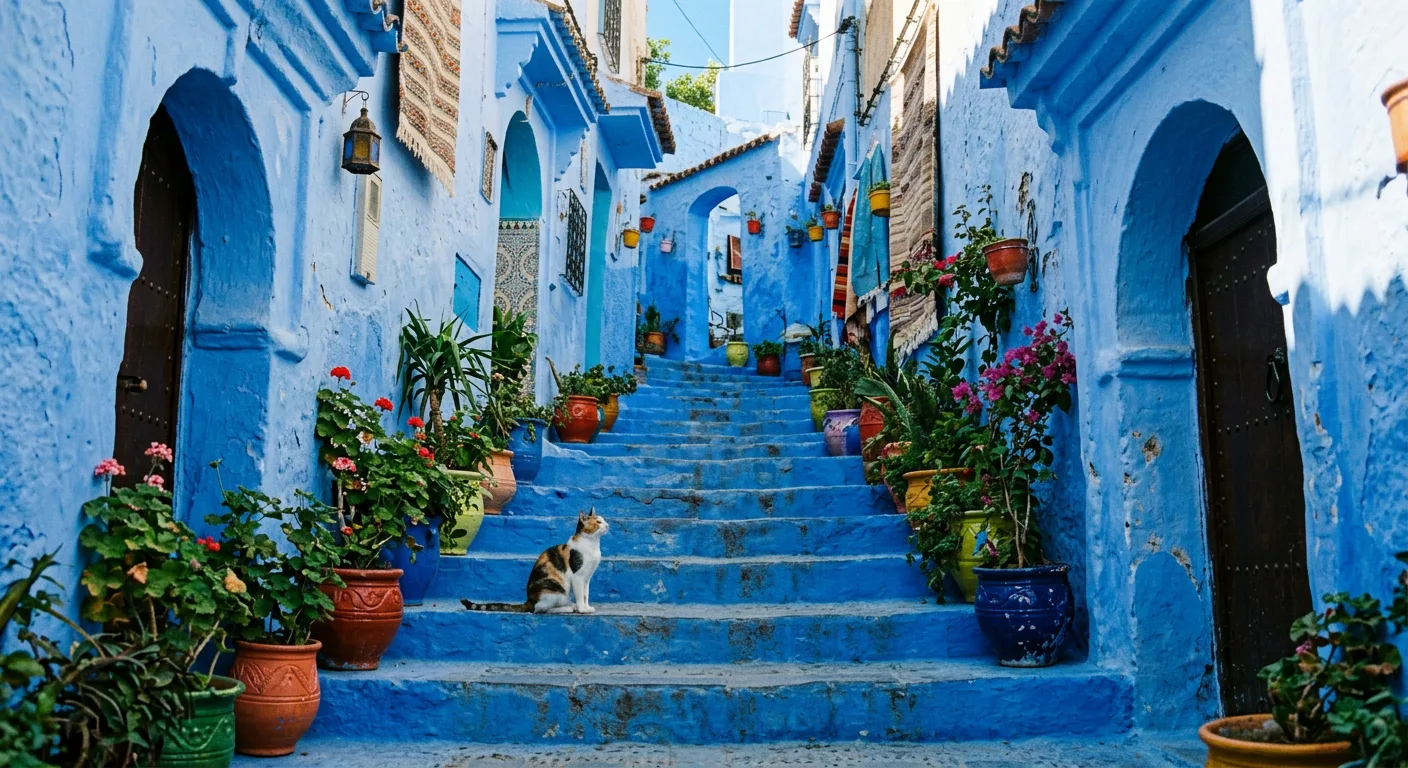
The walled heart of the capital runs from the Atlantic ramparts up to the blue-and-white Kasbah des Oudayas above the Bou Regreg. It is one of the calmest old quarters in Morocco — easy to read on foot, free of the hard sell, and laced with craft streets, sea views and a 12th-century Almohad gate. Here is how to explore Rabat's medina and kasbah.
The monumental Almohad gateway into the Kasbah des Oudayas, built around 1195 under sultan Yacoub al-Mansour. Its carved sandstone arch and geometric bands are among the finest surviving Almohad stonework in Morocco, framing the climb up into the fortress quarter.
02Culture
Blue-and-White Lanes
Inside the kasbah, narrow streets of houses painted white below and Majorelle blue above wind toward the river. The colour scheme, added in the early 20th century, recalls the Andalusian families who settled here after leaving Spain.
03Coast
Oudayas Platform & Sea View
A wide terrace at the kasbah's edge looks out over the mouth of the Bou Regreg, the Atlantic and the white sprawl of Salé across the water. It is the best free viewpoint in the city, especially in late-afternoon light.
04Gardens
Andalusian Gardens
Laid out within the kasbah walls during the French protectorate, these formal terraced gardens shade orange, banana and cypress trees around fountains and tiled paths — a cool, quiet pause between the lanes and the sea.
05Food
Café Maure
A terraced tea house built into the kasbah ramparts, serving sweet mint tea and almond pastries on tables overlooking the river and Salé. A long-standing local ritual rather than a tourist trap.
06Shopping
Rue des Consuls
The medina's historic craft street, once lined with foreign consulates, now Rabat's best address for carpets, leather, brass and the city's famed embroidery. Prices and pressure are gentler than in Fes or Marrakech.
07Shopping
Medina Souks
Beyond Rue des Consuls, covered lanes sell everything from babouche slippers and spices to fabric and household goods. It is a working local market, busiest in the mornings and around the Souika thoroughfare.
08Historic
Seafront Ramparts
The medina's Atlantic walls, partly Almohad and partly later, run above the city beach where the river meets the ocean. A walk along them links the old town to the sands and the surf break below the kasbah.
09Culture
Oudayas Museum
Housed in a 17th-century palace built by the Alaouite sultan Moulay Ismail inside the kasbah, this national museum displays Moroccan jewellery, carpets, ceramics and traditional dress around a small Andalusian courtyard.
10Historic
Bab Mrisa Approach
Looking across the river toward Salé, you can pick out the great Merinid water gate of Bab Mrisa, once large enough for boats to pass through into the medina — a reminder of the twin cities' shared maritime history.
Frequently asked
Is the Kasbah des Oudayas free to enter?
Yes. Walking through the Kasbah des Oudayas, its blue-and-white lanes and the sea-view platform is free. The Andalusian Gardens are also free, while the Oudayas Museum charges a small admission ticket.
Is the Rabat medina safe and easy to walk?
Very much so. Rabat's medina is among the calmest in Morocco — compact, walkable and with little of the hard sell found elsewhere. Ordinary daytime caution for your belongings is enough.
How long do you need for the medina and kasbah?
Allow about half a day. Roughly 90 minutes covers the Kasbah des Oudayas, gardens and a tea at the Café Maure, with another couple of hours for the medina souks and Rue des Consuls.
What should you buy in the Rabat medina?
Rabat is known for fine carpets and embroidery, sold along the historic Rue des Consuls, as well as leather, brassware and babouche slippers in the surrounding souks. Bargaining is expected but relaxed.
See it with a local
Turn this into a private Rabat trip.
We'll build a private, guided plan around the experiences you care about — with a driver, hand-picked riads and a written quote in 24 hours.