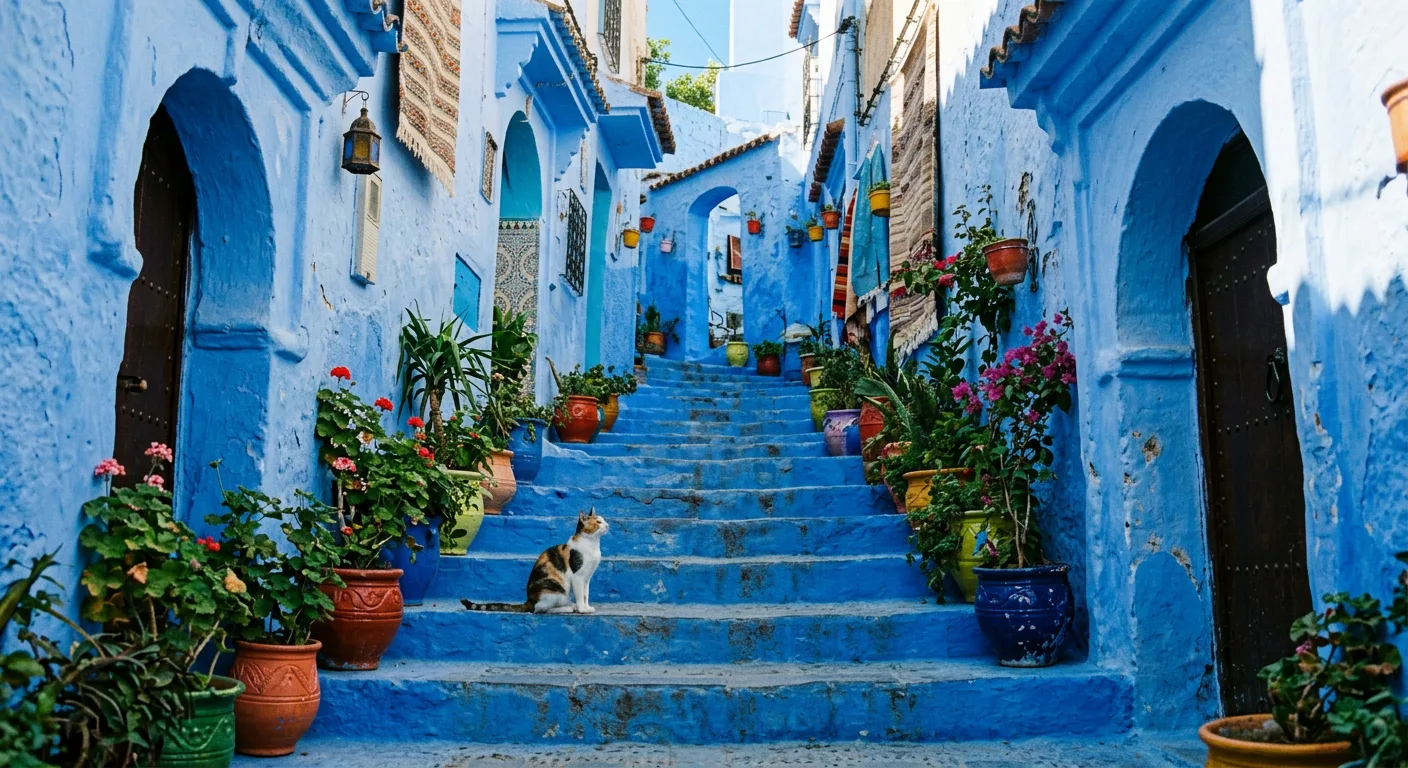
Perched where the Bouregreg river meets the Atlantic, the Kasbah of the Udayas is the oldest and most atmospheric quarter of Rabat. Behind its great Almohad gate lies a small world of blue-and-white lanes, an Andalusian garden, a clifftop café and a platform of old cannon facing the ocean. It is part of Rabat's UNESCO listing, and unlike many photogenic places it remains genuinely lived-in — a working neighbourhood that happens to be beautiful.
Why are the lanes painted blue and white?
The blue-and-white scheme — deep blue on the lower walls, whitewash above — is an Andalusian inheritance. The kasbah took its modern character from waves of Muslims and Moriscos expelled from Spain in the 16th and 17th centuries, who brought the coastal Andalusian aesthetic with them. The same palette appears across the old Andalusian towns of the western Mediterranean; here it gives the narrow lanes their cool, luminous calm.
Today residents maintain the colours themselves, repainting each year, which is why the blue is never uniform — some doorways are cobalt, some almost turquoise, faded by the salt air to a dozen different tones. Walk slowly and you will notice the variation, the studded doors, the potted geraniums and the cats. This is a residential quarter, so photograph with courtesy and avoid framing people's doorways without a smile and a nod.
What is there to see beyond the blue lanes?
Enter through Bab Oudaia, the monumental Almohad gate built around 1195 — one of the finest pieces of medieval stonework in Morocco, its arch framed by bands of carved geometric and floral motifs. Inside, the main lane leads to the platform at the river's mouth, lined with old signal cannon and looking across to Salé and out to the Atlantic. It is the classic spot to watch fishing boats cross the bar.
Off the platform lies the Andalusian Garden, a formal walled garden of orange trees, fountains and bamboo laid out in the colonial period in Andalusian style. It is shaded, fragrant and free, and a fine place to sit. Adjoining it, the Museum of the Oudayas, in a 17th-century palace, holds Andalusian ceramics, carpets and jewellery worth half an hour.
Finally, the Café Maure on the kasbah terrace serves nothing but mint tea and almond pastries on a wide platform above the estuary — touristy, yes, but the view of the river, the city and the ocean earns its place. Go for the late-afternoon light.
How long should you spend here?
The kasbah is compact — you can walk its lanes in thirty minutes — but it rewards a longer, slower visit. Allow an hour and a half to two hours with the garden, the museum and a tea on the terrace. Many guests come twice: once in the bright morning for photographs in the blue lanes, and again at dusk for the Café Maure and the sunset over the Atlantic.
It sits at the top of Rabat's medina, so it is easy to combine a kasbah visit with a wander through the old town and a walk down to the seafront below the walls, where locals gather in the evening.
How do you get to the kasbah?
On foot: the kasbah is at the northern edge of the medina, a 15–20 minute walk from the Ville Nouvelle through Rue Souika and the old town.
By taxi or tram: a petit taxi from anywhere in central Rabat is quick and cheap; the tram and Rabat Ville train station are both within easy reach.
Pairing it: across the Bouregreg stands the Hassan Tower and Mausoleum of Mohammed V, an easy add-on. See our Rabat private tours for itineraries that link the kasbah with the rest of the capital.
Where are the best photography spots?
- Rue Bazo — the most photographed blue lane, with steps and studded doorways. Best at 8–9am or 5–6pm.
- Bab Oudaia — the great gate from outside, in raking afternoon light.
- The platform and cannon — wide views to Salé and the river mouth; best at sunset.
- Café Maure terrace — mint tea in the foreground, the estuary and ocean beyond.
- The Andalusian Garden — orange trees and fountains, soft shade for detail shots.
Frequently asked
Why are the lanes of the Kasbah of the Udayas painted blue and white?
The blue-and-white palette was introduced by Andalusian Muslims and Moriscos who settled in the kasbah after fleeing Spain, and was later reinforced by the area's history. The lower blue, upper white scheme is the classic Andalusian coastal look. It is maintained today as a point of local identity, repainted regularly by residents.
Is the Kasbah of the Udayas worth visiting?
Yes — it is the most atmospheric corner of Rabat. A fortified Almohad citadel above the Bouregreg estuary, it combines the monumental Bab Oudaia gate, blue-washed residential lanes, an Andalusian garden, a small museum and a clifftop café looking out to the Atlantic and Salé. It is compact, free to wander and genuinely lived-in, not a film set.
Is there an entrance fee for the Kasbah of the Udayas?
Walking the kasbah lanes and the platform is free. The Andalusian Garden is free; the small Museum of the Oudayas (housed in a 17th-century palace) and some special exhibitions may charge a modest entry fee. The famous Café Maure on the terrace charges only for your mint tea.
How do you get to the Kasbah of the Udayas?
The kasbah sits at the mouth of the Bouregreg river, at the northern edge of Rabat's medina. From the Ville Nouvelle or Rabat Ville station it is a short petit-taxi ride or a 15–20 minute walk through the medina. It pairs naturally with the Hassan Tower on the opposite riverbank.
What is the best time of day to visit?
Late afternoon is magic — the low sun warms the ochre ramparts and the blue lanes, and the Café Maure terrace fills with locals watching the sunset over the ocean. Early morning is quietest for photographs in the blue streets. Midday is bright and busier but still calm by Moroccan standards.
What should you not miss in the kasbah?
The Almohad gate of Bab Oudaia, one of the finest in Morocco; the blue-and-white residential lanes; the Andalusian Garden with its orange trees and fountains; the platform and signal cannon overlooking the estuary; the Café Maure for mint tea above the water; and the Museum of the Oudayas for Andalusian crafts and jewellery.
Rabat itineraries
We build the kasbah into a day that makes sense.
The Udayas, the medina, the Hassan Tower and Chellah — a calm, walkable capital, an early start and a licensed guide. Tell us what you are looking for.
Request an itinerary