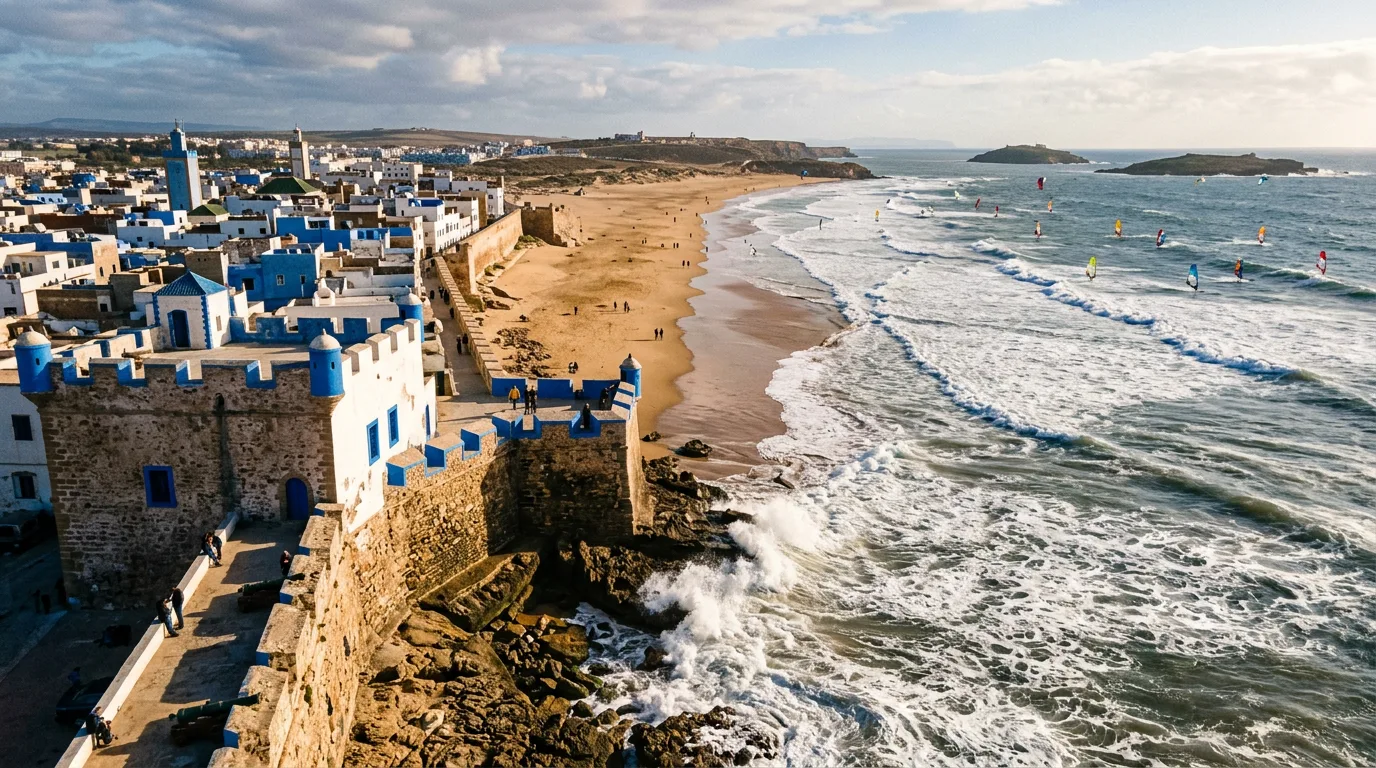
Rabat was built to face the Atlantic and to govern quietly. After the sensory intensity of Marrakech or Fes, it feels like exhaling: wide tree-lined boulevards, a small walkable medina, gardens everywhere, and a river running between the capital and its ancient twin. It is the city Moroccans themselves call restful — and a weekend here is the easiest, most civilised break in the country.
The Kasbah of the Udayas
Begin where Rabat began. The Kasbah of the Udayas crowns the point where the Bouregreg meets the ocean — a fortified Almohad citadel entered through the great gate of Bab Oudaia, with blue-and-white Andalusian lanes inside, a formal Andalusian garden, and the Café Maure terrace looking out over the river and the sea. Go in the late afternoon, when the ramparts glow and the locals gather to watch the sunset. It is the loveliest corner of the capital.
Hassan Tower and the Mausoleum
Upstream stands Rabat's great monument: the Hassan Tower, the unfinished 12th-century minaret of an Almohad mosque meant to be the largest in the world, surrounded by a field of broken columns. Facing it across the esplanade is the Mausoleum of Mohammed V, a masterwork of modern Moroccan craftsmanship in marble, cedar and zellij, guarded by royal sentries. Both are free; allow 60 to 90 minutes for the pair.
Chellah — ruins among the storks
On the city's southern edge lies Chellah, a walled site layered with two histories: a Roman town, abandoned to the grass, and a Merinid royal necropolis built among its ruins, now overgrown with fig and orange and crowned with nesting storks. It is the most atmospheric place in Rabat and blissfully quiet, especially early in the day. The guided visits we arrange bring the Roman and Islamic layers to life.
The medina and the Rue des Consuls
Rabat's medina is small, calm and laid out on a near-grid behind the Andalusian Wall — after Fes and Marrakech, it is a relief. The Rue des Consuls is the historic carpet and craft street; Rue Souika is the busy local market. The bargaining here is gentler, the touting almost absent. Wander, browse, stop for mint tea, and end by climbing up to the kasbah at the top.
Rabat is also a city of museums and gardens: the Mohammed VI Museum of Modern and Contemporary Art, the archaeological collections with the bronzes from Volubilis, and the Andalusian and Test gardens for a quiet hour outdoors.
The river and Salé
The Bouregreg is the heart of the capital. Walk or cycle the riverside promenade, take a small boat or the tram across to Salé — Rabat's older, quieter twin, with its own traditional medina, the jewel-like Bou Inania medersa and a working fishing port — and have a fish lunch by the water. Sunset over the river mouth is one of Rabat's best free pleasures. See the river and Salé guide for how to spend the half-day.
Where to stay
Stay in a riad in the medina or just below the kasbah for atmosphere and walkability, or in a modern hotel in the Hassan quarter or Ville Nouvelle if you prefer to be near the station. We keep a shortlist of properties with honest notes on what each suits — a couple, a family, guests who want the river view. Ask us when you plan the trip through our Rabat destination page.
Getting there and when to go
Rabat sits on the main rail line, so the train is the easiest arrival — under an hour from Casablanca, around 2.5 hours from Fes, and on the through line from Marrakech and Tangier. Rabat Ville station is in the centre. April to May and September to November are ideal: mild Atlantic days, lower crowds and the best light over the water. Summer is warm but cooled by the ocean breeze; winter is quiet and surprisingly mild on the coast compared to the interior.
Frequently asked
Is a weekend long enough for Rabat?
Yes — Rabat is compact and walkable, so a weekend covers the essentials comfortably: the Kasbah of the Udayas, Hassan Tower and Mausoleum, Chellah, the medina and the river. A third day lets you add Salé across the water, the museums, or a train day trip to Casablanca or Meknès without changing hotels.
How do you get to Rabat?
Rabat sits on Morocco's main rail line, so the easiest arrival is by train — under an hour from Casablanca, around 2.5 hours from Fes, and reachable from Marrakech. Rabat-Salé Airport handles some international flights, and Casablanca's Mohammed V Airport is just over an hour away by train. Rabat Ville station is in the heart of the Ville Nouvelle.
Is Rabat good for a relaxed weekend?
Very. As Morocco's calm capital, Rabat is green, low-hassle and easy to navigate, with wide boulevards, gardens, a tram and a walkable medina. It is the city Moroccans themselves describe as restful — a place to slow down between busier destinations rather than rush through.
What are the best places to stay in Rabat?
The medina and the streets below the Kasbah of the Udayas offer atmospheric riads within walking distance of the old town and the river. The Hassan quarter and the Ville Nouvelle around Avenue Mohammed V suit travellers who prefer a modern hotel near the station. Agdal is quiet and residential. The city is small enough that nowhere is far.
Is Rabat safe for solo travellers?
Rabat is consistently rated among the safest and least hassle-prone cities in Morocco. The medina is compact and comfortable to walk by day and into the evening, touts are rare, and solo travellers — including women travelling alone — generally report feeling at ease. Normal city precautions apply at night.
What is the best time of year for a Rabat weekend?
April to June and September to November are ideal: mild Atlantic days, clear light and gentle crowds. Summer is warm but tempered by the ocean breeze, far cooler than inland Morocco. Winter is quiet and occasionally wet, but pleasant for the gardens, museums and a midday river walk.
Rabat calls
Add a calm capital weekend to your Morocco itinerary.
We build Rabat seamlessly into longer programmes — train connections, a handpicked riad, the kasbah, the monuments and a river afternoon. Two nights is the minimum we recommend; three lets you breathe.
Plan your Rabat stay