Rabat rewards the visitor who slows down. After the crowds of Marrakech or Fes, the capital feels almost serene — wide boulevards lined with trees, a flat and unhurried medina, and a river that invites you to linger. Best of all, it is genuinely easy to get around. A modern tram glides through the streets, fast trains connect it to the rest of the country, and most of what you came to see is within walking distance. Here is how it all fits together.
The Rabat-Salé tramway
The standout way to move around the city is the Rabat-Salé tramway — a modern, clean light-rail system with two lines that thread through Rabat and cross the Bouregreg river to neighbouring Salé. It is quiet, frequent and cheap. Buy a rechargeable card (or a single-journey ticket) at a platform machine, top it up, and tap on as you board; each ride costs only a few dirhams. Trams run from early morning until late evening, and because the line crosses the river, the tram doubles as the simplest way to reach Salé without a taxi.
On foot: the calm, green capital
More than most Moroccan cities, Rabat is made for walking. The historic core is flat-ish and pleasant on foot: the medina is compact and far less frantic than its counterparts elsewhere, the Kasbah of the Udayas rises directly above the river, and the Ville Nouvelle — Rabat's elegant modern quarter — is a grid of leafy avenues and cafés. The riverside promenade along the Bouregreg is an easy, level stroll. Comfortable shoes and a half-day are enough to link the medina, the kasbah and the Hassan Tower on foot.
Petits and grands taxis
For short hops, petits taxis are the everyday workhorse — in Rabat they are blue. They are metered, so ask for le compteur or agree the fare before you set off; most rides across the centre cost only a handful of dirhams. They take up to three passengers and stay within the city.
For longer or regional journeys, grands taxis take over — larger, older saloons (often vintage Mercedes) that run shared along fixed routes and leave when full, which makes them cheap if you do not mind sharing. You can also hire a grand taxi privately for an agreed price if you would rather have the car to yourself or reach somewhere off the tram and rail network.
Trains and Al Boraq
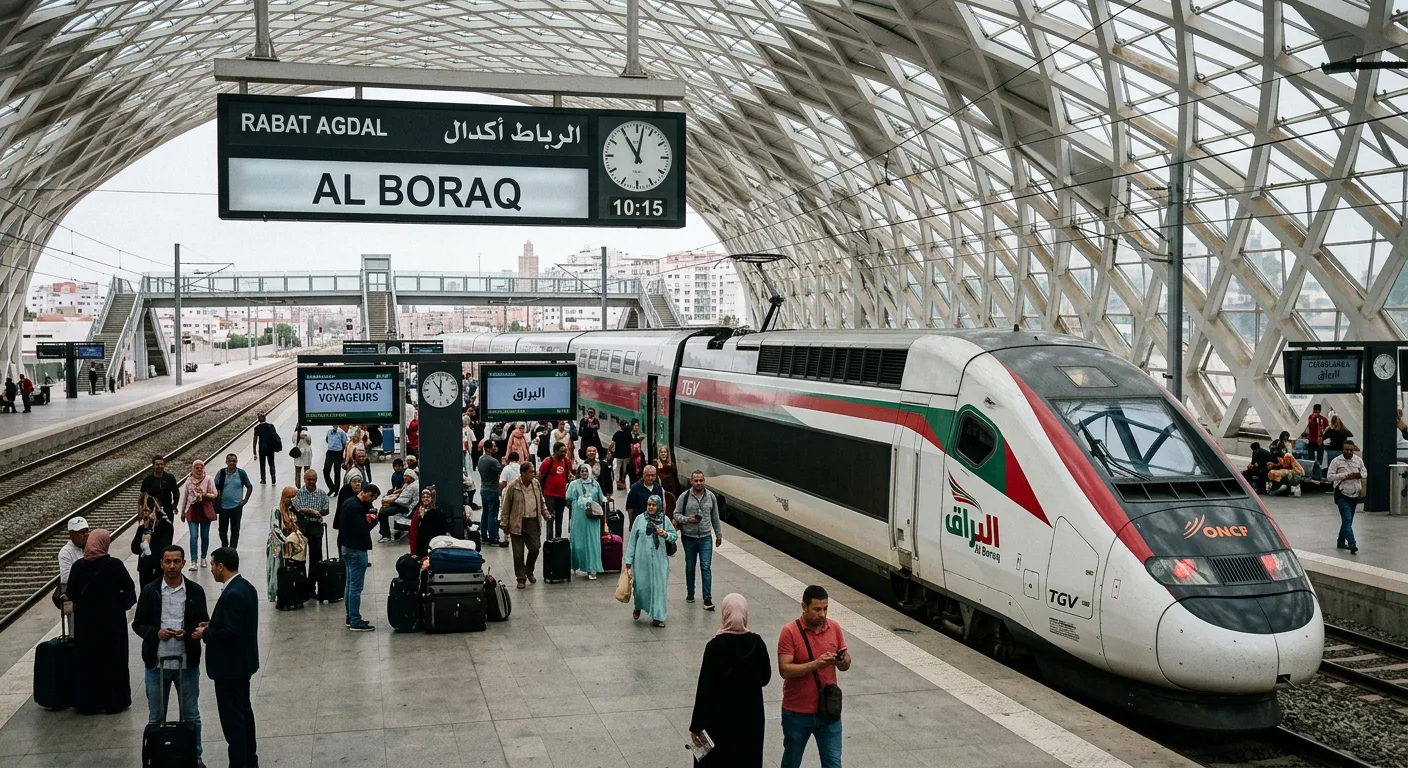
Rabat's great advantage is rail. The city has two central stations: Rabat-Ville, in the heart of the Ville Nouvelle and the most convenient for most visitors, and Rabat-Agdal, the sleek modern station served by the Al Boraq high-speed line. Al Boraq — Africa's first high-speed train — reaches Casablanca in under an hour and Tangier in roughly an hour and a quarter. Frequent ordinary ONCF trains continue to Fes, Meknès and Marrakech. Trains are punctual, air-conditioned and inexpensive, which is exactly why we suggest basing a trip in Rabat and day-tripping out by rail — see our Rabat-based itineraries.
The airport
Rabat-Salé Airport is small and very close — around 10 km from the centre, a short taxi ride away. It handles a modest schedule of mostly regional and European flights. If your flight does not serve it, the usual alternative is to fly into Casablanca's larger Mohammed V Airport and take the direct train up to Rabat, which is quick, frequent and cheap. We can also arrange a private airport transfer either way.
The rowing boat to Salé
One last, lovely option deserves its own mention. Traditional wooden rowing boats, ferried by a boatman, still cross the mouth of the Bouregreg between Rabat and Salé for a few dirhams — a centuries-old crossing that survives alongside the tram. It is slower, but it is the most charming way over the water, weaving between fishing skiffs beneath the kasbah walls. We often suggest taking the boat one way and the tram back; for the full half-day, see our guide to crossing the Bouregreg to Salé.
A few practical tips
- Buy and top up a rechargeable tram card on your first day — it saves queuing for single tickets each time.
- In a petit taxi, ask for the meter (le compteur) or agree the fare first; keep small notes and coins, as drivers rarely have change.
- Grands taxis leave when full and run fixed routes — confirm the destination and whether you are paying for a shared seat or the whole car.
- For day trips, the train is almost always faster and easier than driving; reserve a seat on Al Boraq at busy times.
- You very rarely need a car within Rabat — parking is tight and the medina is car-free. If you are weighing self-driving for the wider region, see our guide to getting around and whether to drive.
Frequently asked
What is the best way to get around Rabat?
For most visitors it is a mix of walking and the tram, with the occasional petit taxi. Rabat is calm, green and flat, so the medina, the Kasbah of the Udayas and the Ville Nouvelle are pleasant on foot. The modern Rabat-Salé tramway covers longer distances across the city and the river, and blue petit taxis fill in the short hops. You rarely need a car.
How does the Rabat-Salé tramway work?
The tramway is a modern, clean light-rail system with two lines that run through Rabat and cross the Bouregreg river to neighbouring Salé. You buy a rechargeable card (or a single-journey ticket) and tap on; fares are a few dirhams per trip. Trams run frequently from early morning until late evening. It is the easiest way to cover the city and to reach Salé without a taxi.
What is the difference between a petit taxi and a grand taxi?
Petits taxis are small metered cabs for short hops inside the city — in Rabat they are blue. Use the meter (le compteur) or agree the fare before you set off; most rides cost only a few dirhams. Grands taxis are larger, usually older Mercedes saloons that run shared, fixed routes for longer or regional journeys, leaving when full. You can also hire a grand taxi privately for an agreed price.
Can I reach Rabat by train, and where are the stations?
Yes. Rabat sits on Morocco's main railway, with two central stations: Rabat-Ville, in the heart of the Ville Nouvelle, and Rabat-Agdal, the modern stop served by the Al Boraq high-speed line. Al Boraq reaches Casablanca in under an hour and Tangier in roughly an hour and a quarter; frequent ordinary ONCF trains also serve Fes, Meknès and Marrakech.
How far is Rabat-Salé airport from the city?
Rabat-Salé Airport is small and very close — around 10 km from the centre, a short taxi ride away. It handles a modest number of mostly regional and European flights. Many visitors instead fly into Casablanca's larger Mohammed V Airport and take the direct train up to Rabat, which is quick and inexpensive.
Is it true you can cross the river to Salé by rowing boat?
Yes — and it is a small delight. Traditional wooden rowing boats, ferried by a boatman, still cross the mouth of the Bouregreg between Rabat and Salé for a few dirhams. It is slower than the tram but far more charming, weaving between fishing skiffs beneath the Kasbah of the Udayas. We often suggest taking the boat one way and the tram back.
Let us handle the logistics
We'll design your days in Rabat — transport and all.
From a private driver-guide and airport transfers to a hand-built itinerary that uses the tram, the train and the river as the locals do, Rabat Tours takes care of every detail so you can simply enjoy the calm capital.
Plan your Rabat trip