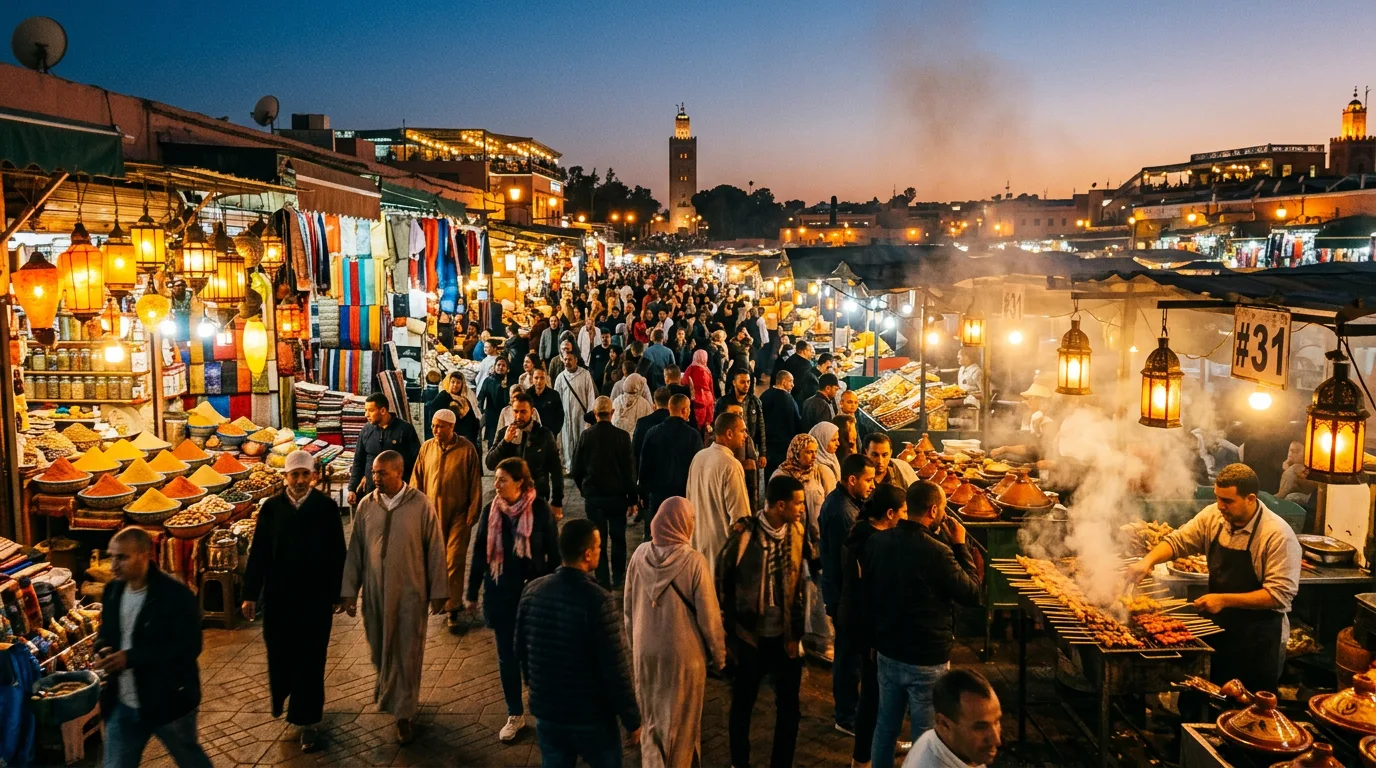
The quick answer first: the easiest way to get from Rabat to Marrakech is the direct ONCF train, which runs from Rabat-Ville (and Rabat-Agdal) straight through to Marrakech in about 3 hours 30 minutes, with no change of train — the same service calls at Casablanca on the way and continues south. The alternative is a private car, around 320 km on the A3 motorway and roughly 3 to 3.5 hours door to door. Here is everything that matters, written by a team that arranges this exact journey most weeks.
The quick comparison
Marrakech sits about 320 km south of Rabat, linked by the national railway and the A3 motorway. Two options make real sense:
| Option | Time | Indicative cost | Best for |
|---|---|---|---|
| Direct train (ONCF Al Atlas) | ~3h 30–3h 40 | ~160–230 MAD 2nd class | Solo travellers and couples, budget, no driving |
| Private car / transfer | ~3–3.5 hours | Fixed quote, per car | Families, groups, luggage, stops, door to door |
| Self-drive hire car | ~3–3.5 hours + tolls | Hire + fuel + tolls + parking | Onward road trips beyond Marrakech |
Fares are indicative and change with class and demand — confirm the current price on the official ONCF channels (oncf-voyages.ma or the ONCF app) before you travel.
Option 1: the direct train (what most people take)
This is the option we recommend for most travellers. ONCF, Morocco's national railway, runs frequent Al Atlas trains from Rabat-Ville and Rabat-Agdal that go straight through to Marrakech. The journey takes about 3 hours 30 minutes to 3 hours 40 minutes, and the crucial point is that you do not change trains — the service calls at Casablanca's Casa-Voyageurs station, then carries on south across the plains to Marrakech while you stay in your seat. Departures run through most of the day, roughly hourly, so there is almost always a convenient train.
Al Atlas trains are clean, air-conditioned and have first and second class, with reserved seating on some services. Buy your ticket in advance on oncf-voyages.ma or the ONCF app, or at the station window. A second-class seat is typically around 160–230 MAD (roughly US$16–23); first class a little more. Booking a day or two ahead is sensible in summer and around Moroccan public holidays, when the corridor is busy. If you want the wider picture of Morocco's rail network before you travel, our guide to getting around Rabat covers the trams, taxis and the Al Boraq high-speed line.
Why there is no Al Boraq high-speed train to Marrakech (yet)
A common question, and worth being precise about: Morocco's Al Boraq high-speed trains — Africa's first — currently run only on the northern corridor, Tangier–Kénitra–Rabat–Casablanca. They do not reach Marrakech. The high-speed extension south of Casablanca toward Marrakech is under construction but is not yet open, so for now the fast Al Boraq line stops at Casablanca.
In practice this changes nothing for your trip. You could ride Al Boraq the short hop from Rabat to Casa-Voyageurs and then change onto an onward Al Atlas service to Marrakech — but because the direct Al Atlas train already runs straight through without a change, that connection saves no meaningful time and adds the faff of switching trains. For Rabat to Marrakech today, the direct Al Atlas train is the smart choice.
Option 2: a private car, door to door
A private transfer covers the same 320 km on the A3 motorway in about 3 to 3.5 hours, and takes you from your riad door in Rabat to your riad door in Marrakech — including the final walk-in if your Marrakech accommodation sits inside the car-free medina. It is the relaxed choice if you are travelling as a family or group, have heavy luggage, or simply want to skip station logistics. The price is fixed in writing before you travel, with no meter.
The other reason to take a car is the chance to stop along the way. The road passes Casablanca, so you can break the journey at the Hassan II Mosque on the Atlantic, or pause for lunch, before continuing south. It is also the natural option if you are heading on the same day beyond Marrakech — to the Atlas Mountains, Essaouira or the desert. We arrange these as fixed-price private transfers or as a guided day on the road; just tell us your plans and we will quote it.
What about self-driving or flying?
Self-driving is straightforward — the A3 is a good toll motorway — but for a one-way city-to-city hop it rarely beats the train or a transfer once you add the hire cost, fuel, tolls and the hassle of parking a car inside Marrakech, where the medina is largely car-free. A hire car makes sense mainly if you plan an onward road trip from Marrakech rather than a single transfer.
Flying is not a practical option here: there is no useful scheduled passenger flight directly between Rabat-Salé (RBA) and Marrakech (RAK), and the cities are close enough that any air routing would take longer than the train once you count airport time at both ends. For the full case for using Rabat as your base in the first place, see our piece on basing yourself in Rabat.
Which Rabat station to leave from
Rabat has two central stations, and trains to Marrakech call at both:
- Rabat-Ville — in the heart of the Ville Nouvelle, the most convenient if you are staying near the medina or the Kasbah of the Udayas.
- Rabat-Agdal — the modern station in the Agdal district, handy if you are staying on that side of the city. It is also the city's Al Boraq high-speed stop.
Board at whichever is closer to your hotel — the train to Marrakech serves both. If you are still deciding where to stay, our neighbourhood guide helps you choose your base.
Arriving in Marrakech
Trains arrive at the grand Marrakech railway station on Avenue Mohammed VI in Guéliz, the modern district, about 3 km from the famous Jemaa el-Fnaa square and the medina. Petits taxis wait outside; agree the fare or ask for the meter before you set off. If your Marrakech riad is deep inside the medina, the taxi will drop you at the nearest gate and a porter can wheel your bags the last few minutes on foot. If you have booked a private transfer with us instead, your driver takes you all the way to the door.
Frequently asked
How do I get from Rabat to Marrakech?
The easiest way is the direct train. ONCF runs frequent Al Atlas trains from Rabat-Ville (and Rabat-Agdal) straight through to Marrakech in about 3 hours 30 minutes to 3 hours 40 minutes, with no change required — the same train carries on through Casablanca to Marrakech. The alternative is a private car, roughly 320 km on the A3 motorway and about 3 to 3.5 hours of driving door to door. Driving yourself or flying are both possible but rarely worth it: there is no direct passenger flight between Rabat and Marrakech, and the train is faster, cheaper and more relaxing than self-driving.
Is there a high-speed Al Boraq train from Rabat to Marrakech?
Not yet. Morocco's Al Boraq high-speed line currently runs Tangier–Kénitra–Rabat–Casablanca only; it does not reach Marrakech. The high-speed extension south of Casablanca toward Marrakech is under construction and not yet open. For now, Rabat to Marrakech is served by ONCF's conventional Al Atlas trains, which are comfortable and air-conditioned but run at normal speed. You can ride Al Boraq the short hop from Rabat to Casablanca and change there, but on this route it saves no meaningful time over simply taking the direct Al Atlas train.
How long does the train from Rabat to Marrakech take?
About 3 hours 30 minutes to 3 hours 40 minutes on a direct Al Atlas service. The train leaves Rabat, calls at Casablanca (Casa-Voyageurs), then continues south across the plains to Marrakech without you having to change trains. Trains run through most of the day, roughly hourly, so there is almost always a convenient departure.
How much does the train from Rabat to Marrakech cost?
It is good value. A second-class ticket is typically in the region of 160–230 MAD (roughly US$16–23), with first class a little more — often around 240–300 MAD. Fares change and depend on class and demand, so confirm the current price and book on the official ONCF channels (oncf-voyages.ma or the ONCF app) or at the station window. Booking a day or two ahead is wise in summer and around Moroccan public holidays.
Do I need to change trains in Casablanca?
No — the direct Al Atlas trains run straight through. Your train stops at Casa-Voyageurs but you stay in your seat; the same service continues to Marrakech. The only time you would change is if you specifically wanted to ride the Al Boraq high-speed train for the Rabat–Casablanca leg, in which case you would switch at Casa-Voyageurs onto an onward Al Atlas service. For most travellers the no-change direct train is simpler and just as quick.
Should I take the train or hire a private car from Rabat to Marrakech?
Take the train if you want the cheapest, easiest option city-centre to city-centre — it is comfortable, frequent and avoids motorway tolls and parking. Choose a private car if you are travelling as a family or group, have a lot of luggage, want door-to-door service from your riad, or would like to stop along the way — for example at Casablanca's Hassan II Mosque or for lunch. A private transfer is also the relaxed choice if you are continuing the same day to the Atlas Mountains, Essaouira or the desert beyond Marrakech.
Can I fly from Rabat to Marrakech?
There is no practical scheduled passenger flight directly between Rabat-Salé (RBA) and Marrakech (RAK) — the cities are too close for a useful domestic air route, and any indirect routing would take far longer than the train once you factor in airport time. For Rabat to Marrakech, the train or a private car are the two sensible choices.
Make the journey effortless
A fixed-price car from your Rabat door to your Marrakech riad.
Prefer not to manage stations and connections? Rabat Tours arranges a comfortable, fixed-price private transfer from Rabat to Marrakech — with stops along the way if you like — or builds it into a complete Morocco itinerary so every leg is handled before you arrive.
Plan your journey