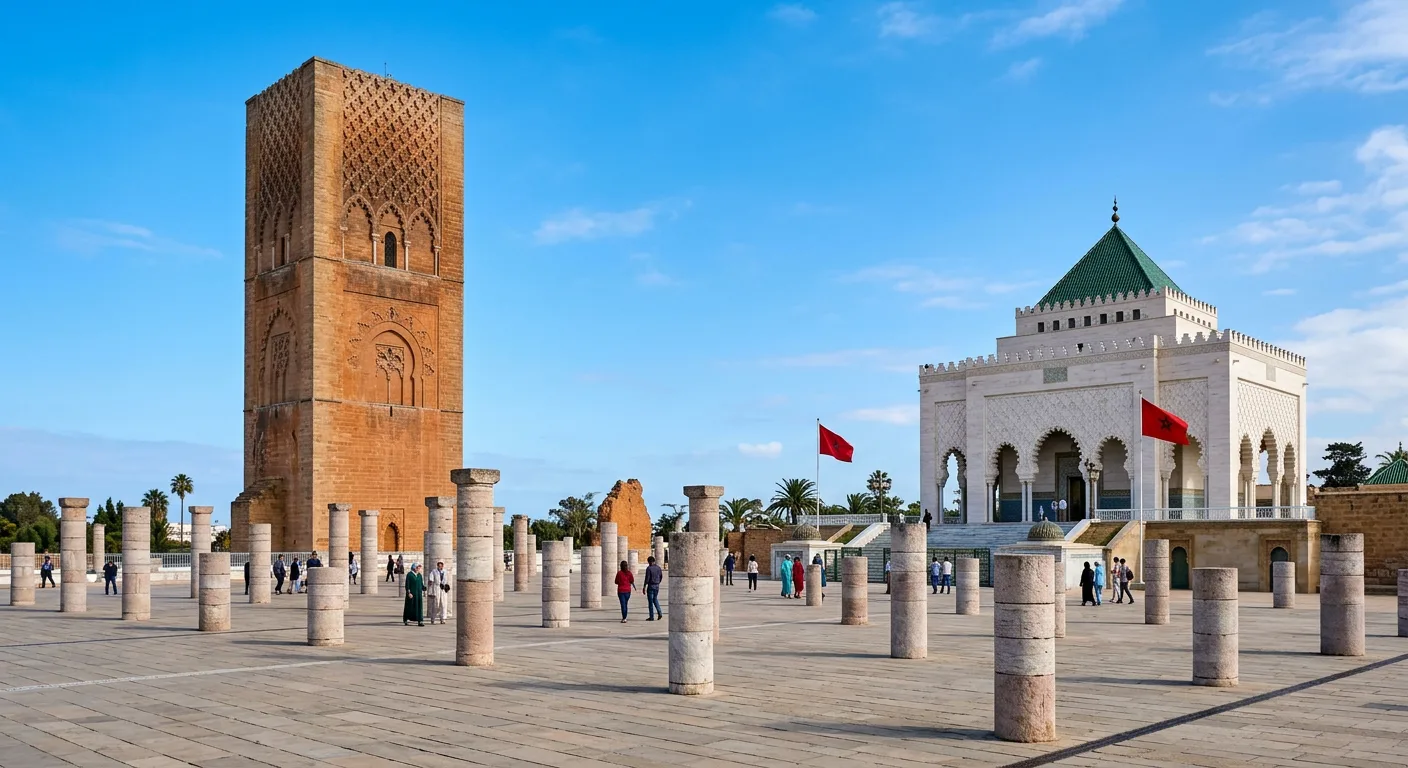
The short, honest answer: yes — Rabat is worth visiting. Morocco's capital is calm, walkable and a UNESCO World Heritage Site, and you can see its headline sights — the Kasbah of the Udayas, Hassan Tower and the Mausoleum of Mohammed V, and the Chellah — in a single relaxed day, two if you slow down. It also makes a genuinely low-stress base: Salé is across the river, Casablanca is under an hour by train, and Meknes with the Roman ruins of Volubilis is an easy day inland. Below is everything that matters, from a team based here who plans these days every week.
So — is Rabat actually worth it?
Rabat is the city most itineraries skip, and that is exactly why it rewards you. There is no hard-sell in the medina, no crush of tour groups, and the pace is closer to a Mediterranean capital than the sensory overload of Marrakech. You get an authentic walled medina, a royal-monument quarter, a Roman-and-Merinid ruin full of nesting storks, and an Atlantic corniche — all in a city you can cross in twenty minutes by tram. If you want one Imperial city done gently, with real history and breathing room, Rabat is the answer. For the full case, see our piece on basing yourself in Rabat.
The one caveat: Rabat is a place to settle into, not a checklist to sprint. If you only want big bazaars and snake charmers, you may find it quiet. If you want atmosphere, gardens, sea air and a base for exploring the surrounding region, it is one of Morocco's most underrated stops.
What should I see in a day?
One full day covers the essentials. Here is the rhythm we recommend:
- Kasbah of the Udayas — start in this blue-and-white walled quarter above the river, with the Andalusian Gardens and a mint-tea terrace over the Atlantic. Our complete Udayas guide maps it out.
- Hassan Tower & the Mausoleum of Mohammed V — the unfinished 12th-century minaret beside a field of columns, facing the marble royal mausoleum with its mounted guards. See the Hassan Tower visitor's guide.
- The Chellah — a walled Roman town and Merinid necropolis just outside the centre, where storks nest on the old minarets. The Chellah ruins explained has the history.
- The medina & the sea — finish with a wander through the calm medina down to the corniche, using our walking guide to the Rabat medina.
And with a second day?
A second day lets you slow down properly. Add the Andalusian Gardens, the Mohammed VI Museum of Modern and Contemporary Art (Morocco's flagship art museum), the Ville Nouvelle along Avenue Mohammed V, and an afternoon on the Bouregreg river and the corniche. In the evening, cross the water to Salé for its quieter medina and the Grand Mosque. If you are weighing how long to give the city overall, our guide to how many days in Rabat breaks it down by trip length.
Which nearby trips are worth it?
This is where Rabat earns its keep as a base. Everything below is a comfortable out-and-back day. The honest times — door to door, one way — are these:
| Trip | Distance / time | Worth it for |
|---|---|---|
| Salé | Across the river · ~15 min | A quieter medina, the Grand Mosque, boat across the Bouregreg |
| Casablanca | ~90 km · under 1 hr by train | The vast Hassan II Mosque on the ocean; a fast, easy outing |
| Meknes | ~140 km · ~2 hrs | Imperial gates, Bab Mansour, granaries — pairs with Volubilis |
| Volubilis & Moulay Idriss | ~150 km · ~2–2.5 hrs | Morocco's best Roman ruins; the holy hill town nearby |
| The coast (Kénitra / Mehdia) | ~40 km · ~45 min | Atlantic beaches, surf and the Sidi Boughaba lagoon |
Times are typical door-to-door estimates and vary with traffic and where you start in Rabat. Train times to Casablanca are frequent throughout the day on ONCF.
Salé — the easiest of all
You can see Salé in an afternoon. It sits directly across the Bouregreg, reachable by tram, taxi or a small rowing boat from below the Kasbah. It is quieter and more workaday than Rabat, with its own historic medina and a beautiful Grand Mosque. Our Rabat-to-Salé guide and the Rabat vs Salé comparison cover the crossing and which side suits you.
Meknes & Volubilis — the big history day
This is the standout inland trip. Volubilis is the best-preserved Roman site in Morocco — mosaics in situ, a triumphal arch and a basilica, set among green hills — and it pairs naturally with the holy town of Moulay Idriss and the Imperial city of Meknes, with its monumental Bab Mansour gate, granaries and stables. From Rabat it is about 2 to 2.5 hours each way, so treat it as a full day. A private car makes this far smoother than juggling trains and grand taxis, because the three sights are spread out.
Casablanca — the fast, modern outing
Casablanca is barely an hour from Rabat by frequent train, which makes it the easiest day trip of all. The main reason to go is the colossal Hassan II Mosque, built out over the Atlantic — one of the largest mosques in the world, and one of the few in Morocco non-Muslims can tour inside. It is a half-day in itself; add the corniche or the old medina if you have time.
The coast — beaches and surf
If you want sea rather than monuments, the Atlantic is right there. Rabat's own corniche and beaches sit below the Kasbah, and just north, Kénitra and Mehdia Beach offer wider sand, surf and the Sidi Boughaba bird lagoon — about 45 minutes away. It is the relaxed counterpoint to a history-heavy itinerary.
When should I go?
Spring (April–May) and autumn (September–October) are ideal — warm, dry days, mild evenings, gardens at their best. Summer is pleasant on the coast because the Atlantic keeps Rabat cooler than the interior, though inland day trips to Meknes and Volubilis get hot. Winter is mild but can be wet. One date to note: the Mawazine music festival fills the city for nine June nights — wonderful, but book early. The full picture is in our best time to visit Rabat guide.
How to put it together
For most travellers we suggest three to four nights in Rabat: two unhurried days in the city, one day for Meknes and Volubilis, and a half-day to Salé or Casablanca depending on your taste. Getting around the city itself is simple by tram and taxi — see getting around Rabat — while the further day trips are easiest with a driver who handles the logistics. We arrange both the city days and the regional trips as private, fixed-price Rabat tours; just tell us your dates and we will shape it around you.
Frequently asked
Is Rabat worth visiting?
Yes — Rabat is worth visiting, especially if you want a calm, walkable Moroccan city with real depth rather than crowds and hard-sell. It is Morocco's capital and a UNESCO World Heritage Site, and you can comfortably see its headline sights — the Kasbah of the Udayas, Hassan Tower and the Mausoleum of Mohammed V, and the Chellah ruins — in a single relaxed day. It also makes an excellent, low-stress base: Salé is across the river, Casablanca is under an hour by train, and Meknes and the Roman ruins of Volubilis are an easy day trip inland. If you only have time for one Imperial city and want it gentle, Rabat is a strong choice.
How many days do you need in Rabat?
One full day covers the essentials — the Kasbah of the Udayas at golden hour, Hassan Tower and the Mausoleum, the Chellah, and a wander through the medina to the Atlantic. Two days lets you slow right down: add the Andalusian Gardens, the Mohammed VI Museum of Modern and Contemporary Art, the river and the corniche, and an evening across the water in Salé. If you want to use Rabat as a base for day trips to Meknes, Volubilis or the coast, plan three to four nights so you keep a couple of unhurried days in the city itself.
What are the top three things to see in Rabat?
The Kasbah of the Udayas — a blue-and-white walled quarter above the Bouregreg river, with the Andalusian Gardens and a café terrace over the Atlantic. Hassan Tower and the Mausoleum of Mohammed V — the unfinished 12th-century minaret beside a courtyard of columns, facing the marble royal mausoleum guarded by mounted sentries. And the Chellah — a walled Roman town and Merinid necropolis where storks nest on the minarets, just outside the centre. All three are close together and walkable or a short taxi apart.
Is Volubilis worth visiting as a day trip from Rabat?
Yes, if you like Roman history — Volubilis is the best-preserved Roman site in Morocco, with mosaics still in place, a triumphal arch and a basilica, set in green hills near the holy town of Moulay Idriss. From Rabat it is roughly a two-to-two-and-a-half-hour drive each way, so it is a full day, usually paired with Meknes, the nearby Imperial city. If you are short on time and Roman ruins are not your priority, the Chellah inside Rabat gives you a smaller taste closer to home.
Should I do a day trip to Meknes or to Casablanca from Rabat?
It depends on what you want. Meknes is the Imperial-city day — massive gates, the Bab Mansour, granaries and stables, and it pairs naturally with Volubilis, about 2 to 2.5 hours' drive from Rabat. Casablanca is the modern, big-city day — the colossal Hassan II Mosque on the ocean is the main reason to go, and it is barely an hour away by frequent train, so it is the easier, shorter trip. Choose Meknes/Volubilis for history and atmosphere, Casablanca for the mosque and a fast, simple outing.
When is the best time to visit Rabat?
Spring (April–May) and autumn (September–October) are ideal: warm, dry days and mild evenings, with the gardens at their best. Summer is comfortable on the coast — Rabat stays cooler than the interior thanks to the Atlantic — but inland day trips to Meknes and Volubilis get hot. Winter is mild but can be wet and windy. If you want music and energy, the Mawazine festival fills the city for nine nights in June; book accommodation early for that week.
Let us plan it
Rabat, its monuments and the region — handled door to door.
From a relaxed day in the capital to Volubilis, Meknes, Salé, the coast or the Hassan II Mosque in Casablanca, Rabat Tours builds a private, fixed-price plan around your dates — so every drive time and ticket is sorted before you arrive.
Plan your Rabat trip