The honest version, up front: Morocco is co-hosting the 2030 FIFA World Cup alongside Spain and Portugal, and Rabat — the Moroccan capital — is one of the announced Moroccan host cities, with a stadium project associated with the wider Rabat area. Almost everything else travellers want to pin down — the exact match schedule, dates and kick-off times, ticket prices, the stadium's final name and capacity, and fan-zone details — is not yet confirmed. Treat anything specific you read as provisional until FIFA and local authorities publish official information closer to the event. This guide's value is being early, accurate and genuinely useful for forward planning — not pretending to know specifics nobody has yet announced.
What we will and won't tell you
We state only what has been officially confirmed. Where details are still open, we say so plainly and point you to check official sources nearer the time. You will not find invented dates, prices, capacities or schedules on this page — by design.
What is actually confirmed about Rabat hosting?
Two things are settled. First, the 2030 FIFA World Cup is being co-hosted by Morocco, Spain and Portugal — a tournament spread across the three countries. Second, Rabat is one of the Moroccan host cities that has been announced, and there is a stadium project associated with the Rabat area. That is the firm ground.
Beyond that, the specifics are still being worked out. The detailed match schedule, which games are played where, exact dates, the final venue name and seating capacity, ticketing arrangements and prices, and official fan-zone plans had not been finalised at the time of writing. Anyone quoting precise numbers this far out is guessing. When the official announcements come, they will come from FIFA and the local organising bodies — so those are the sources to watch, and the ones we will update this page against.
When should I start planning and booking?
Start familiarising yourself now, and book the moment official information lands. For an event of this scale, the two things that tighten first are flights and a place to sleep in the host city — and they tend to climb in price as dates firm up. A measured plan looks like this:
- Now: learn how to reach Rabat, which neighbourhood you'd want to stay in, and what you'd do in the city between matches (all covered below). No money down — just groundwork.
- When FIFA opens official ticketing: buy match tickets only through official channels. Be cautious of anyone selling "guaranteed" tickets or all-in "World Cup packages" before official sales open.
- As soon as dates are confirmed: lock in flights and accommodation early. Host-city beds for major tournaments fill quickly.
We are not selling World Cup packages, and we would not trust anyone who is — yet. What we can do now is help you understand the city so you're ready to move fast when the real details arrive. When you're planning the trip itself, tell us your dates and we'll shape the non-match days around you.
How do I get to Rabat?
This part is genuinely easy, and it is the same whether or not there is a tournament on. Rabat sits on Morocco's Atlantic rail spine, and the country's high-speed line makes the capital very reachable:
| Coming from | How | Roughly |
|---|---|---|
| Casablanca | Al Boraq high-speed / frequent ONCF trains | ~1 hour or under |
| Tangier | Al Boraq high-speed line | ~1.5 hours |
| Casablanca airport (CMN) | Direct airport train, or private transfer | ~1.5 hours by train |
| By air to Rabat | Rabat-Salé airport (smaller) or fly into CMN | Varies by route |
Times are typical and vary with the service and where you start. Any special World Cup-period transport will be announced officially nearer the event. Most visitors fly into Casablanca Mohammed V — the country's largest airport — and take the train up. For the full breakdown, see our Casablanca airport to Rabat guide and getting around Rabat.
Where should I stay?
Rabat is compact and well linked by tram and petit taxi, so you don't need to be beside any one place to get around. The areas that work best:
- The medina & Kasbah of the Udayas — atmospheric old-city riads, walkable to the river and monuments.
- Centre-ville & Hassan — central, near the station and Hassan Tower, easy for trains.
- Agdal — modern, leafy and full of cafés and restaurants.
- Salé & the marina side — quieter, often better value, just across the Bouregreg.
Whichever you pick, book as early as official dates allow — host-city rooms for a tournament go fast. Our neighbourhood guide and where to stay in Rabat cover who each area suits and what a riad actually is.
What is there to do in Rabat between matches?
This is where Rabat shines, tournament or not. The capital is a UNESCO World Heritage Site and one of Morocco's calmest, most walkable cities, and its headline sights cluster close together:
- Kasbah of the Udayas — a blue-and-white walled quarter above the river, with the Andalusian Gardens and a mint-tea terrace over the Atlantic. Our Udayas guide maps it out.
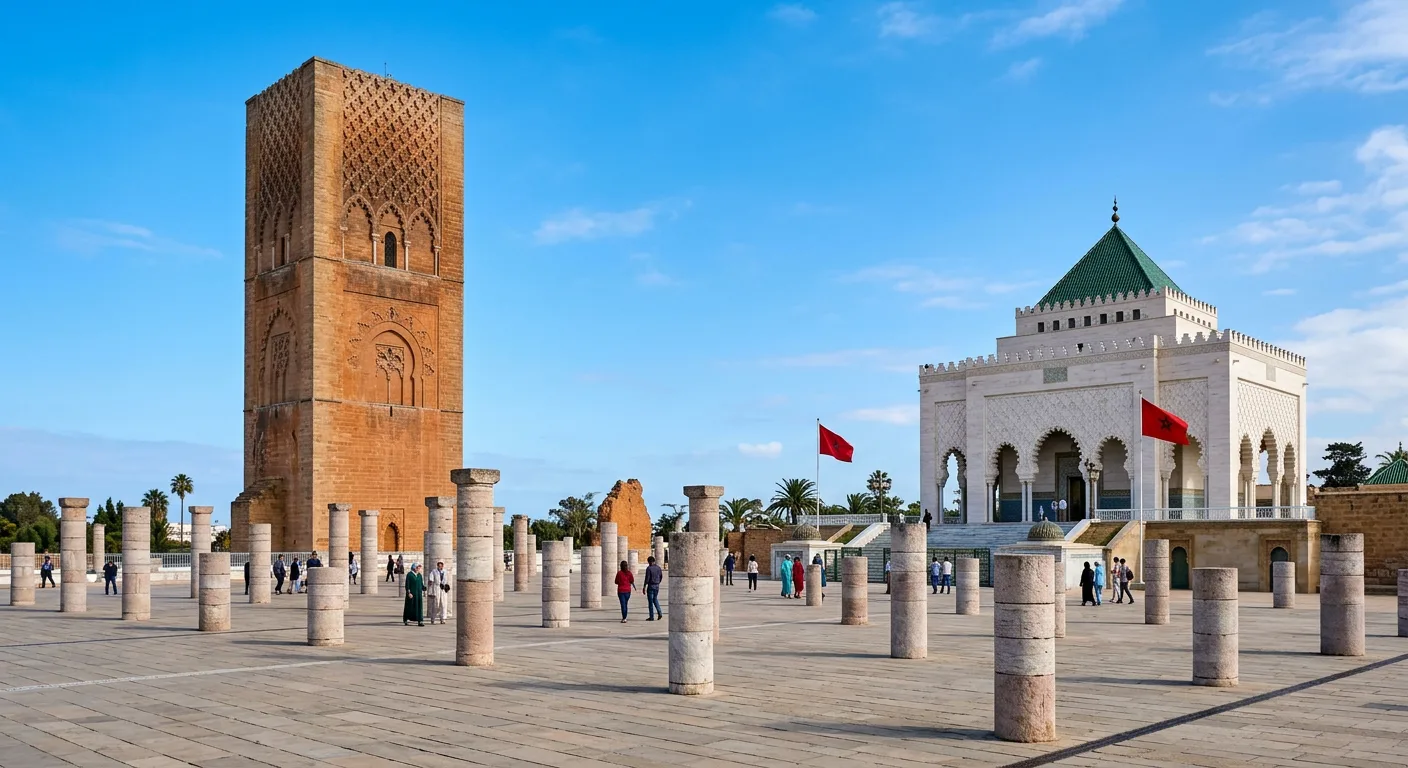
- Hassan Tower & the Mausoleum of Mohammed V — the unfinished 12th-century minaret beside a field of columns, facing the marble royal mausoleum. See the Hassan Tower guide.
- The Chellah — a walled Roman town and Merinid necropolis where storks nest on the old minarets. The Chellah explained has the history.
- The medina & the sea — a calm old town that lets you breathe, down to the Atlantic corniche. Use our medina walking guide.
Add the Mohammed VI Museum of Modern and Contemporary Art, the Bouregreg river and an evening across the water in Salé, and you have full, unhurried days between any fixtures. If you want a ready-made rhythm, our Rabat in three days plan and how many days in Rabat both help.
Easy day trips from Rabat
Rabat is a strong base, and the surrounding region is full of easy out-and-back days — handy if your match days are spread out. Honest one-way times:
| Trip | Distance / time | Worth it for |
|---|---|---|
| Salé | Across the river · ~15 min | A quieter medina, the Grand Mosque, the boat crossing |
| Casablanca | ~90 km · under 1 hr by train | The vast Hassan II Mosque on the ocean |
| Meknes | ~140 km · ~2 hrs | Imperial gates, Bab Mansour — pairs with Volubilis |
| Volubilis & Moulay Idriss | ~150 km · ~2–2.5 hrs | Morocco's best-preserved Roman ruins |
| The coast (Kénitra / Mehdia) | ~40 km · ~45 min | Atlantic beaches, surf and the Sidi Boughaba lagoon |
Times are typical door-to-door estimates and vary with traffic. Our full guide to Rabat and its nearby trips goes deeper on each, and Rabat to Marrakech covers the longer haul south.
Is Rabat worth visiting outside the World Cup too?
Comfortably, yes. The football is a reason to come in 2030; the city is a reason to come in any year. Rabat is the capital most itineraries skip, and that is exactly why it rewards you — no hard-sell in the medina, no crush of tour groups, gardens and sea air, and real depth of history at a gentle pace. For the full case, see is Rabat worth visiting and why base yourself in Rabat. If you're weighing the season, our best time to visit guide helps — though for the World Cup, the schedule will decide your dates.
The bottom line
Rabat is officially on the 2030 World Cup map, and that is exciting. But the useful, honest position right now is simple: get to know the city, decide where you'd stay and what you'd do, and be ready to book the instant FIFA and local authorities confirm the details. Don't pay for specifics nobody has announced. When the schedule lands, you'll already understand the destination — and we can help with the non-match days, the day trips and the logistics. Just get in touch.
Frequently asked
Is the 2030 World Cup schedule confirmed yet?
No. As of mid-2026 the match schedule, exact dates, kick-off times and which fixtures land in which Moroccan city are not finalised. What is confirmed is that Morocco is co-hosting the 2030 FIFA World Cup with Spain and Portugal, and that Rabat is one of the announced Moroccan host cities. Treat any specific dates, venues, ticket prices or stadium details you see elsewhere as provisional until FIFA and the local organisers publish official information closer to the event. We deliberately do not quote figures we cannot yet verify.
When should I start planning and booking for Rabat?
Begin planning early and book the moment official information is released. For a global event of this size, flights and accommodation in a host city tend to be the first things to tighten and the first to rise in price. A sensible approach: get familiar with how to reach Rabat and where you would want to stay now, then move quickly on official ticketing, flights and a place to sleep as soon as FIFA and the airlines confirm dates. Until then, nothing is bookable as a 'World Cup package' that we would trust — be wary of anyone selling guaranteed match tickets before official sales open.
How do I get to Rabat for the World Cup?
Rabat sits on Morocco's Atlantic spine and is easy to reach. The Al Boraq high-speed line links Tangier, Kénitra, Rabat and Casablanca, putting Casablanca around an hour or less away and Tangier roughly an hour and a half; standard ONCF trains run frequently along the same corridor. Many visitors fly into Casablanca Mohammed V (CMN), the country's largest airport, then take the direct train up to Rabat; Rabat has its own smaller airport (Rabat-Salé) as well. Exact World Cup-period transport arrangements and any special services are not yet announced.
Where should I stay in Rabat?
Rabat is compact and well connected by tram and taxi, so several areas work. The medina and the Kasbah of the Udayas put you in the atmospheric old city; Centre-ville and the Hassan district are central and walkable; Agdal is modern and leafy; and the Salé and marina side across the Bouregreg is quieter and often better value. Whatever you choose, book as early as official dates allow — host-city accommodation fills fast for major events. Our neighbourhood guide breaks down who each area suits.
What is there to do in Rabat between matches?
Plenty, and it stays useful whether or not you are here for football. The headline sights — the Kasbah of the Udayas, Hassan Tower and the Mausoleum of Mohammed V, and the Chellah ruins — sit close together and fill a relaxed day. Add the calm medina, the Andalusian Gardens, the Mohammed VI Museum of Modern and Contemporary Art, the Bouregreg river and the Atlantic corniche. Rabat is a UNESCO World Heritage Site and one of Morocco's gentlest cities to explore on foot.
Is Rabat worth visiting outside the World Cup too?
Yes. Rabat is worth a trip in any year — it is the calm, walkable capital that most itineraries skip, with real history and breathing room rather than crowds. It also makes a low-stress base for day trips: Salé is across the river, Casablanca is under an hour by train, and Meknes with the Roman ruins of Volubilis is an easy day inland. The World Cup is a reason to come in 2030; the city is a reason to come any time.
Plan ahead with us
Ready for 2030 — the city, the day trips and the logistics, handled.
We won't sell you specifics nobody has confirmed. What we will do is help you make the most of Rabat around the football — a relaxed day in the capital, Volubilis and Meknes, the Hassan II Mosque in Casablanca, the coast — as a private, fixed-price plan built around your dates once they're set.
Plan your Rabat trip