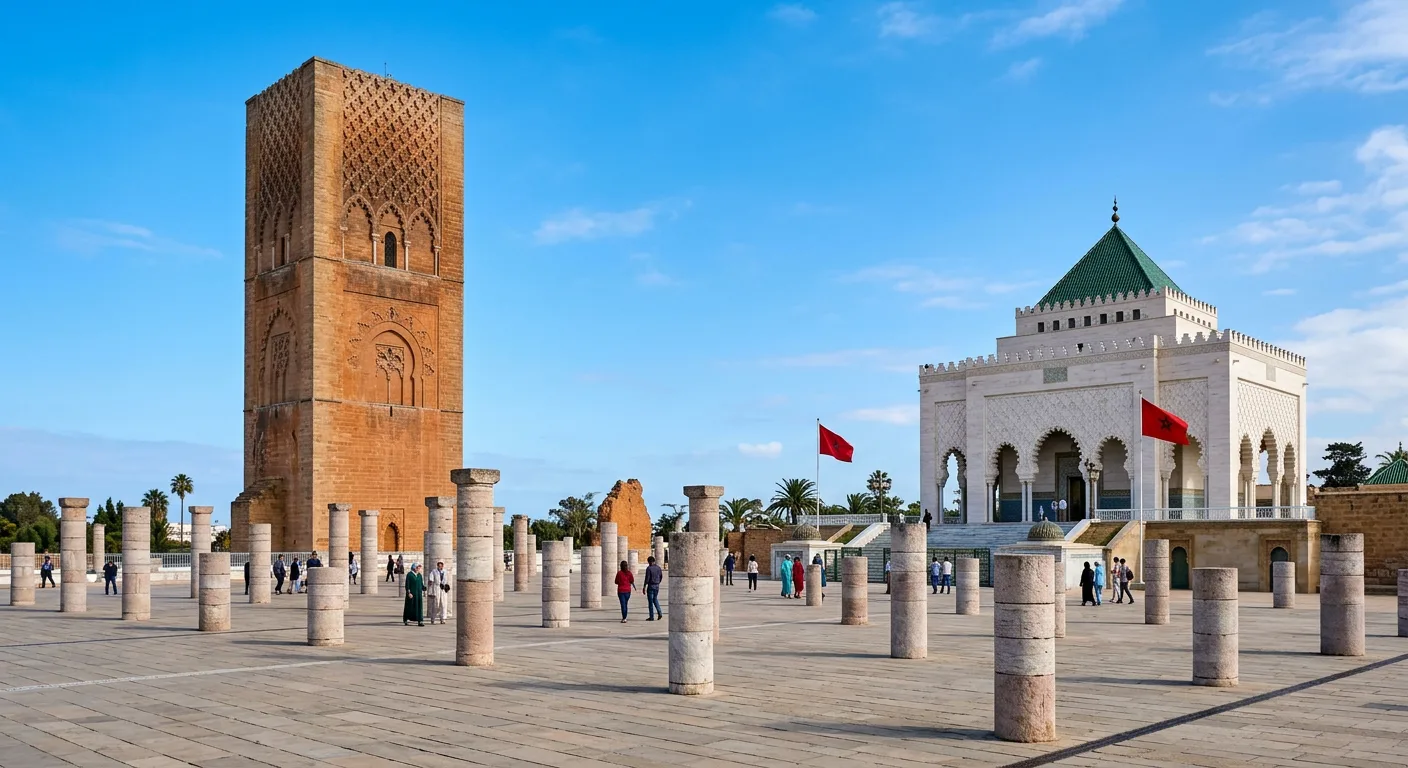
The short answer, up front: Rabat is one of Morocco's most rewarding and relaxed culture stops — a UNESCO World Heritage capital that pairs the Kasbah of the Udayas, Hassan Tower and the Chellah ruins with the country's flagship modern-art museum, the Mohammed VI Museum of Modern and Contemporary Art — and you can see the highlights comfortably in a day. If you want one Moroccan city for art and history without the crowds and hard-sell of Marrakech or Fes, the capital is the quiet answer.
A note on the museum's details
Opening days, hours, ticket prices and what is on display at the Mohammed VI Museum all change with the programme and the season. We deliberately do not quote figures that may be out of date — always check the museum's official site for the current exhibition and admission details before you go.
Is Rabat worth visiting for its art and culture?
Yes — and arguably more than any other Moroccan city if culture is what you're after, because Rabat lets you actually take it in. It is the capital and a UNESCO World Heritage Site, but the pace is closer to a Mediterranean capital than to the sensory overload of the southern medinas. There is no crush of tour groups in the kasbah, no aggressive selling in the souk, and the headline sights are spread across a small, walkable city you can cross in twenty minutes by tram. That calm is the point: it is a place to look properly at things rather than be hurried past them.
What makes Rabat distinct is the breadth. In one compact capital you get a living walled medieval kasbah, a quarter of royal monuments, a layered Roman-and-Merinid ruin full of nesting storks, an authentic medina, and — the piece most itineraries miss — Morocco's flagship modern-art museum. For the broader case, including the day trips beyond the city, see our companion piece on whether Rabat is worth visiting and which nearby trips repay the drive; this guide stays in the city and leads with the culture.
The Mohammed VI Museum of Modern & Contemporary Art
Start with the sight most visitors don't know Rabat has. The Mohammed VI Museum of Modern and Contemporary Art — the Musée Mohammed VI d'art moderne et contemporain, usually shortened to MMVI — opened in 2014 as Morocco's first major purpose-built museum dedicated to modern and contemporary art. Before it, the country had no national home of this scale for its painters and sculptors; its arrival was a genuine turning point for how Moroccan art is collected and shown.
Inside you'll find two things. A permanent collection tracing twentieth-century and contemporary Moroccan art — the best single place to follow the arc of the country's modern artistic identity under one roof — and a rotating programme of temporary and international touring exhibitions, which have at times brought major European masters to the capital on loan. Because that programme changes, the experience is different each visit; allow roughly an hour or two, a little more when a big show is on.
It sits centrally on Avenue Mohammed V, within easy reach of the Ville Nouvelle, the train station and the medina, so it slots naturally into a day of city sightseeing — a cool, reflective hour between the open-air monuments. One honest caveat: opening days, hours and ticket prices, and what is actually on display, all rotate, so check the official site before you plan around it. For a fuller breakdown, our guide to the Mohammed VI Museum and our wider Rabat museums and art guide go deeper.
A one-day culture route through Rabat
Here is the rhythm we recommend for a single, unhurried day. Everything below is walkable or a short petit-taxi apart.
Kasbah of the Udayas
Begin in Rabat's loveliest corner: a blue-and-white walled quarter above the Bouregreg, entered through the great Almohad gate of Bab Oudaia. Wander the quiet lanes to the Andalusian Garden, then take mint tea on the café terrace looking out over the Atlantic and across to Salé. Go early or late for the soft light and the empty alleys. Our complete Udayas guide maps it out.
Hassan Tower & the Mausoleum of Mohammed V
A short hop brings you to Rabat's great monument: the unfinished 12th-century Almohad minaret known as Hassan Tower, rising over a field of broken columns, with the marble Mausoleum of Mohammed V facing it across the esplanade, guarded by mounted royal sentries. It is open, free to walk and quietly stirring. See our Hassan Tower and Mausoleum guide for the history.
The Chellah
Just outside the centre lies the Chellah — a walled site where a Roman town and a Merinid royal necropolis are layered together, half-wild with gardens and famous for the storks that nest on the old minarets. It is the most atmospheric ruin in the city and an easy add to the day. The Chellah ruins explained covers what you're looking at and the best hour to go.
The medina & Rue des Consuls
Finish in the medina, which after Fes and Marrakech feels like a relief — small, calm and behind the Andalusian Wall. The Rue des Consuls is the historic street of consulates turned craft market, the best place to watch Rabati carpets, leather and brass being sold without the pressure. Our medina walking guide and shopping the Rabat medina cover the route and what to buy. Fold in the Mohammed VI Museum on Avenue Mohammed V whenever the heat or your feet call for an hour indoors, and the day is complete.
How long do you need?
One full day covers the highlights — the Udayas, Hassan Tower and the Mausoleum, the Chellah, the medina, and an hour or two at the Mohammed VI Museum if art is your thing. A second day lets you slow right down: add the Andalusian Gardens, the Ville Nouvelle architecture along Avenue Mohammed V, the Bouregreg river and the Atlantic corniche, and an evening across the water in Salé. If you're weighing it up, our how many days in Rabat guide and the Rabat in three days plan break it down by trip length. As a rule of thumb: a day for the essentials, two to settle in, three or more if you also want to day-trip from the city.
How to get to Rabat
This part is genuinely easy. Rabat sits on Morocco's Atlantic rail spine, and the country's high-speed line makes the capital very reachable.
| Coming from | How | Roughly |
|---|---|---|
| Casablanca | Al Boraq high-speed / frequent ONCF trains | ~1 hour or under |
| Tangier | Al Boraq high-speed line | ~1.5 hours |
| Casablanca airport (CMN) | Direct airport train, or private transfer | ~1.5 hours by train |
| By air to Rabat | Rabat-Salé airport (smaller) or fly into CMN | Varies by route |
Times are typical and vary with the service and where you start. Most visitors fly into Casablanca Mohammed V — the country's largest airport — and take the train up. For the full breakdown, see our Casablanca airport to Rabat guide and getting around Rabat.
Combine it with a day trip
Once you've given the city its day, Rabat makes a calm base for the surrounding region. Salé is across the river for a quieter medina and medersa; Meknes and the Roman ruins of Volubilis are the standout inland history day; and Casablanca — barely an hour away by train — is an easy half-day for the colossal Hassan II Mosque. Our full guide to Rabat and its nearby trips goes deeper on each. We run these as private, fixed-price days — the Rabat capital full-day private tour for the city itself, the Meknes & Volubilis UNESCO day trip, and the Casablanca & Hassan II Mosque day.
The bottom line
Rabat is the Moroccan capital most itineraries skip, and that is exactly why it rewards a culture-minded traveller: real depth and breathing room in equal measure. The Mohammed VI Museum gives you the country's modern art under one roof; the Udayas, Hassan Tower, the Chellah and the medina give you a thousand years of history in a single walkable day. Check the museum's hours and current show before you go, give the city a day at minimum — and let us shape the rest around you. Just tell us your dates.
Frequently asked
Is Rabat worth visiting for its museums and culture?
Yes — Rabat is one of Morocco's most rewarding and relaxed culture stops. It is the capital and a UNESCO World Heritage Site, and it pairs a walled medieval kasbah, royal monuments and Roman-and-Merinid ruins with the Mohammed VI Museum of Modern and Contemporary Art, the country's flagship modern-art museum. The pace is far calmer than Marrakech or Fes, there is no hard-sell, and the headline sights sit close together, so a culture-focused traveller can see the best of the city comfortably in a single day.
What is the Mohammed VI Museum of Modern and Contemporary Art?
It is Rabat's flagship art museum — the Musée Mohammed VI d'art moderne et contemporain, usually shortened to MMVI — on Avenue Mohammed V in the centre of the city. It opened in 2014 as Morocco's first major purpose-built museum dedicated to modern and contemporary art. It holds a permanent collection tracing twentieth-century and contemporary Moroccan painting and sculpture, alongside a rotating programme of temporary and international touring exhibitions. Because the displays and shows change, it is worth checking the official site for the current exhibition, opening days and ticket details before you go.
Can you see Rabat's main sights in one day?
Comfortably, for the highlights. A relaxed single day covers the Kasbah of the Udayas, Hassan Tower and the Mausoleum of Mohammed V, the Chellah ruins and a wander through the medina, with an hour or two for the Mohammed VI Museum if you enjoy art. They are close together — walkable or a short taxi apart — and the city is small and gentle. Give it two days if you want to slow right down, add the Andalusian Gardens and the corniche, and cross the river to Salé.
How do you get to Rabat?
Easily. Rabat sits on Morocco's Atlantic rail spine, and the Al Boraq high-speed line links Tangier, Kénitra, Rabat and Casablanca — putting Casablanca around an hour or less away and Tangier roughly an hour and a half; frequent standard ONCF trains run the same corridor. Most visitors fly into Casablanca Mohammed V (CMN), the country's largest airport, then take the direct train up to Rabat; the city also has its own smaller Rabat-Salé airport.
How much are tickets to the Mohammed VI Museum and when is it open?
Admission, opening days and hours can change, and major touring exhibitions sometimes carry their own arrangements, so we do not quote figures that may be out of date. Check the museum's official channels for the current programme and ticket details before visiting, and plan around a day the galleries — and the exhibition you want to see — are open.
What else is there in Rabat for culture lovers?
Beyond the headline sights, Rabat rewards a slower look: the Andalusian Gardens inside the Udayas, the artisan workshops and Rue des Consuls in the medina, the Ville Nouvelle's early-twentieth-century architecture along Avenue Mohammed V, and a calendar of cultural events — Jazz au Chellah among the ruins and the vast Mawazine festival in June. Across the Bouregreg, Salé adds its own historic medina and medersa. It is a capital that reveals more the longer you give it.
Let us plan it
Rabat's art, monuments and medina — handled in a single day.
From the Mohammed VI Museum and the Kasbah of the Udayas to Hassan Tower and the Chellah, Rabat Tours builds a private, fixed-price culture day around your dates — and adds Salé, Meknes and Volubilis or Casablanca when you want to range further.
Plan your Rabat trip